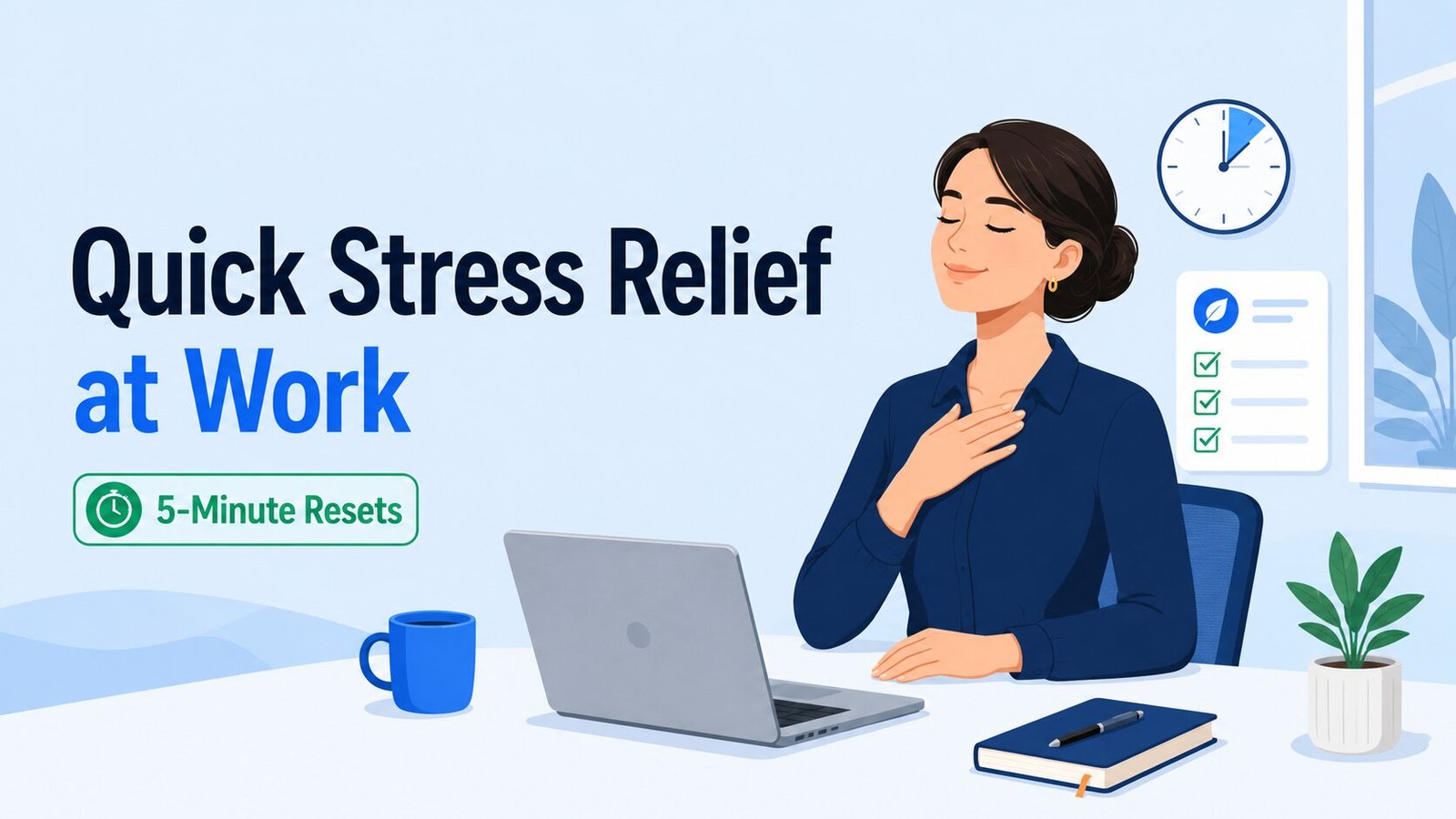
Some work stress needs bigger changes, such as clearer priorities, better boundaries, or a more realistic workload. But sometimes, you just need a quick reset before the next meeting, message, or task.
A few minutes may not fix the whole day, but it can help you slow down, release some tension, and choose your next step with a clearer mind. That matters when you are feeling rushed, distracted, or close to reacting too quickly.
These quick stress relief techniques at work are designed for normal workdays. You can use them at your desk, between meetings, after a tense message, or whenever you need a short pause without stepping away for a long break.
When Quick Stress Relief Helps Most
Quick stress relief works best in small moments when you need to steady yourself before moving on. It is not meant to solve every source of work stress, but it can help you respond to the next part of your day with more control.
These techniques can be useful when:
- a meeting is about to start and your mind feels scattered
- a message or email makes you tense
- you have too many tasks open at once
- your body feels stiff after sitting for a long time
- you are avoiding a task because it feels too big
- you need to switch from one task to another
- work thoughts are still following you at the end of the day
The best technique depends on what is happening in that moment. A tense body may need movement. A crowded mind may need a quick written reset. A stressful message may need a pause before you reply.
For ongoing stress, the CDC recommends healthy coping habits such as taking breaks, stretching, making time to unwind, and connecting with others.
The 60-Second Breathing Reset

Use this when you feel rushed, tense, or close to reacting too quickly. A short breathing reset gives your body and mind a brief pause before you continue.
You do not need a complicated method. Sit back or stand still, relax your shoulders, and breathe in gently. Then breathe out slowly, as if you are giving yourself a little more space before the next action.
Try this for 60 seconds:
- Put both feet on the floor.
- Relax your jaw and shoulders.
- Breathe in gently through your nose.
- Breathe out slowly.
- Repeat until your body feels a little less rushed.
This works well before a meeting, after a difficult message, or when you notice yourself moving too fast from one task to another. The point is not to remove all stress in one minute. It is to slow the rush enough to respond more clearly.
The 3-Line Mental Reset
Use this when your mind feels crowded and you are not sure what to focus on next. This can happen when several tasks, messages, and deadlines are all competing for attention at the same time.
Open a note, planner, or blank document and write three lines:
- What is stressing me right now?
- What actually needs my attention next?
- What can wait?
This small reset helps you separate real next steps from mental noise. You may realize that only one task needs action right now, while the rest can be handled later.
For example, if you are thinking about a report, two emails, a meeting, and a follow-up message, your next step may simply be: “Finish the report summary first.” That one clear action can make the next few minutes feel easier to start.
The Tense Message Pause
Use this when an email, chat message, or comment makes you feel pressured, annoyed, or misunderstood. In those moments, replying quickly can feel satisfying, but it may also make the situation more stressful.
Before you send anything, give yourself a short pause.
Try this:
- Write the reply you want to send.
- Remove anything that sounds sharp, defensive, or unclear.
- Ask yourself, “What outcome do I need from this message?”
- Wait a few minutes, then read it again before sending.
A calm reply does not mean you ignore the problem. It means you choose words that help move the conversation forward instead of adding more tension.
For example, instead of writing, “I already explained this,” you could write, “I can clarify that. The main point is…” This keeps the message useful without carrying the stress into the conversation.
The Desk Tension Release

Use this when stress shows up in your body. You may notice tight shoulders, a clenched jaw, stiff hands, or restlessness after sitting for too long.
You can do a quick tension release without leaving your desk:
- Drop your shoulders away from your ears.
- Unclench your jaw and relax your face.
- Roll your shoulders slowly a few times.
- Stretch your fingers and wrists.
- Stand up for a moment if you can.
This is not a full workout or a long break. It is a small physical reset that helps your body stop holding stress in the same position for too long.
It can be especially helpful after long meetings, focused work, or any moment when you realize you have been sitting still while feeling tense.
The Between-Meeting Reset
Use this when one meeting ends and another is about to start. Back-to-back meetings can make your mind feel crowded because you do not get enough time to close one conversation before entering the next.
A short reset can help you switch context more clearly:
- Stand up or change your posture.
- Take a few slow breaths.
- Write one key takeaway from the last meeting.
- Write one thing you need to focus on in the next meeting.
- Clear your screen before joining again.
This helps you avoid carrying every open thought from one meeting into the next. Even two or three minutes can make the next conversation feel less rushed.
The 5-Minute First Step
Use this when you know what needs to be done, but the task feels too big to start. This can happen with reports, presentations, planning work, difficult emails, or anything that needs more focus than you feel ready to give.
Instead of trying to finish the whole task, make the first step small enough to begin.
Try this:
- Set a timer for 5 minutes.
- Open the task or document.
- Choose one small action.
- Work only on that action until the timer ends.
- Decide whether to continue or pause.
The first action could be simple: create the document, write the first sentence, review one section, organize your notes, or list three points you need to include.
This technique works because starting is often the hardest part. Once the task is open and moving, it usually feels less heavy than it did in your head.
Use a 5-Minute Reset Between Tasks
Use this when you are switching from one task to another and your mind still feels stuck on what came before. This can happen after finishing a call, sending an important update, reviewing a long document, or handling several small requests in a row.
Instead of jumping straight into the next task, take a few minutes to create a cleaner transition.
Try this:
- Close tabs or files you no longer need.
- Move notes from the previous task out of the way.
- Write the next task in one clear sentence.
- Take one slow breath before you start.
- Open only what you need for the next step.
This reset helps reduce the messy feeling that comes from carrying too many open loops at once. The workday may still be busy, but each task gets a clearer starting point.
The End-of-Day Stress Drop
Use this when the workday is ending, but your mind is still holding unfinished tasks, loose ends, or tomorrow’s worries. This is not a full evening routine. It is a quick way to stop carrying everything in your head.
Before you close your work tools, write down three things:
- What is unfinished?
- What is the first task for tomorrow?
- What can wait?
This gives your mind a place to put the work instead of trying to remember it all after hours.
You may still have things to do tomorrow, but you do not have to keep mentally reopening them all evening. A short written note can make it easier to step away with a little more closure.
When a Quick Reset Is Not Enough
Quick stress relief techniques can help you calm the moment, but they are not meant to fix every work problem. If the same stress keeps coming back every day, the issue may need more than a five-minute reset.
A quick technique may not be enough if stress is coming from:
- unrealistic workload
- unclear expectations
- constant interruptions
- repeated after-hours work
- lack of support
- ongoing conflict
- pressure that affects your sleep, mood, health, or relationships
In those situations, quick resets can still help you get through the day, but they should not be the only solution. You may need to look at your workload, set clearer boundaries, ask for priority clarity, or get support from a manager, HR, an employee assistance program, or a qualified professional.
Quick Recap: Which Technique Should You Use?
Different stressful moments need different kinds of resets. Use this quick guide when you are not sure where to start.
| If you feel… | Try this technique |
|---|---|
| Rushed, tense, or reactive | The 60-second breathing reset |
| Mentally overloaded | The 3-line mental reset |
| Annoyed by a message or email | The tense message pause |
| Tight in your shoulders, jaw, or hands | The desk tension release |
| Drained between meetings | The between-meeting reset |
| Stuck before starting a task | The 5-minute first step |
| Scattered between tasks | A 5-minute reset between tasks |
| Unable to switch off after work | The end-of-day stress drop |
You do not need to use every technique in one day. Choose the one that matches the moment you are in. A small reset works best when it is simple enough to actually use.
Note: These techniques are for general informational purposes and may help with everyday work stress. They are not a substitute for professional medical or mental health advice. If stress feels overwhelming or starts affecting your daily life, consider speaking with a qualified professional or using support resources available in your workplace or local area.
FAQs About Quick Stress Relief at Work
What is the quickest way to relieve stress at work?
The quickest way to relieve stress at work is to pause, slow your breathing, and focus on one clear next step. This helps you stop reacting to everything at once.
How can I calm down at work in 5 minutes?
Try a simple 5-minute reset: breathe slowly, relax your shoulders, write down what needs your attention next, and step away from the screen if possible.
What can I do after a stressful meeting?
Take a minute to breathe, write one key takeaway from the meeting, and choose your next action before opening another task. This helps you move forward without carrying the whole meeting into the rest of your day.
Can quick stress relief techniques really help?
Yes, they can help in the moment, especially when you feel tense, overloaded, or close to reacting too quickly. But if the same stress keeps returning, you may need to look at workload, boundaries, expectations, or support.
When should I get help for work stress?
Consider getting more support if work stress regularly affects your sleep, mood, health, relationships, or ability to work normally. Depending on your situation, support may come from a manager, HR, an employee assistance program, a doctor, therapist, or counselor.