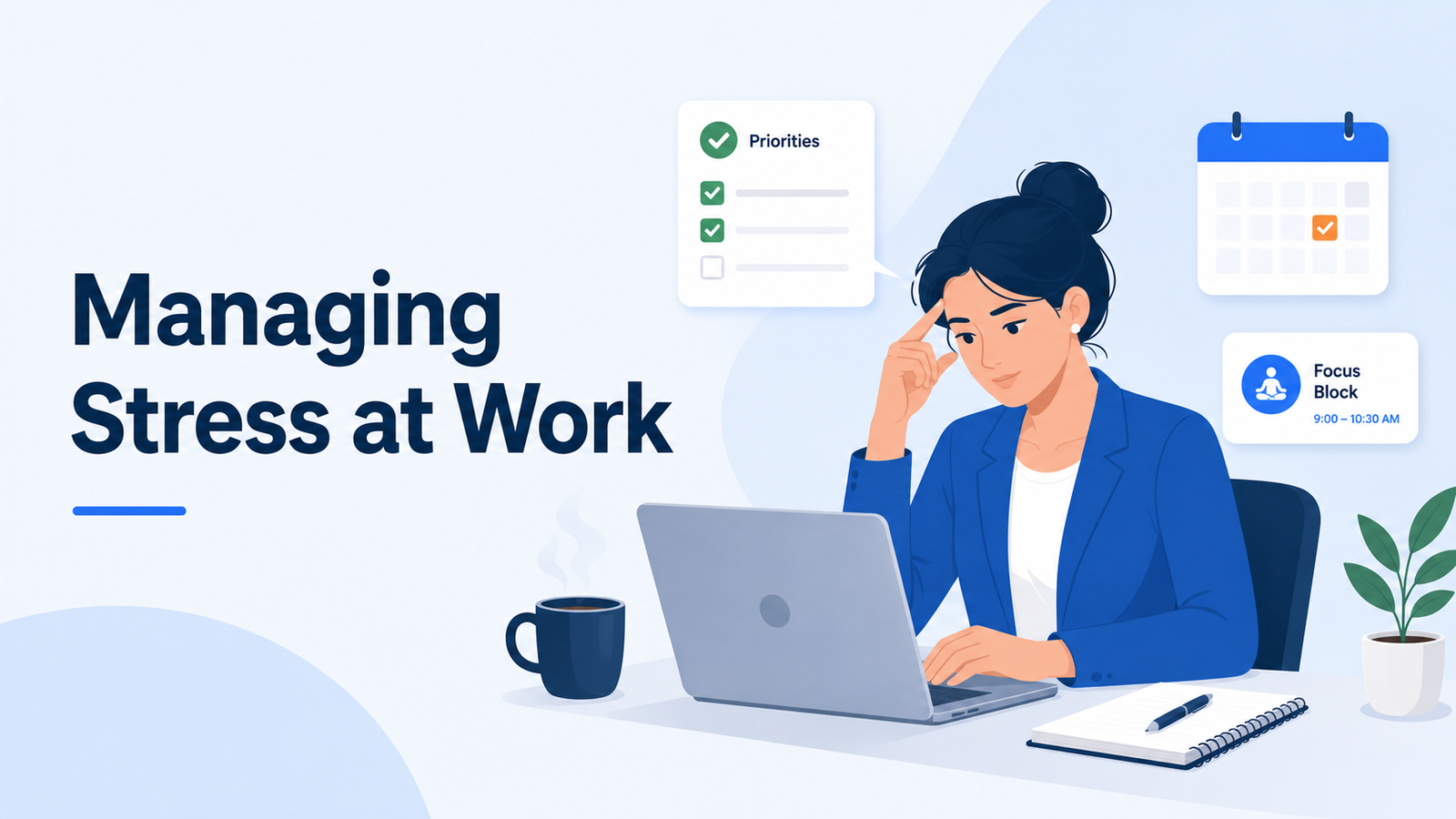
Work stress does not always show up as one big problem. Sometimes, it builds slowly through back-to-back meetings, unclear priorities, constant messages, tight deadlines, and the feeling that you are always trying to catch up.
That pressure can make even a normal workday feel heavier than it should. You may jump between tasks without finishing anything, feel tense before opening your laptop, or end the day tired while your mind is still thinking about work.
Managing stress at work is not about staying calm every minute or pretending the pressure is not real. It is about understanding what is draining your energy, making your workload easier to see, and using small practical steps to feel more in control of your day.
What Work Stress Can Look Like
Work stress can look different for different people. For some, it feels like a tight deadline or a difficult conversation. For others, it feels like a constant background pressure that follows them through the day.
You may notice it when you struggle to focus, feel irritated by small requests, or keep checking messages even when nothing urgent is happening. You may also feel mentally tired before the day is over, even if you have been sitting at a desk most of the time.
Sometimes, work stress shows up after the workday ends. You may keep thinking about unfinished tasks, replay conversations in your head, or feel like you cannot fully relax. When this happens often, it is a sign that work is taking more energy than it should.
Why Stress Builds Up at Work
Work stress usually does not come from one task alone. It often builds when too many small pressures stack up without enough space to pause, reset, or focus.
Common reasons include:
- Unclear priorities: Everything feels important, so it becomes hard to know what to do first.
- Too many interruptions: Messages, calls, meetings, and quick requests break your focus throughout the day.
- Unrealistic deadlines: The work may be possible, but not within the time or resources available.
- Constant task switching: Moving between emails, meetings, projects, and admin work can make even a normal day feel scattered.
- Lack of control: Stress can increase when you have little say over your schedule, workload, or how work gets done.
- Poor boundaries: Work can feel heavier when messages, tasks, or worries keep following you after hours.
- Limited support: It is harder to manage pressure when expectations are unclear or help is not easy to ask for.
This is why managing stress at work is not only about calming down in the moment. It also means looking at how your work is planned, communicated, and interrupted during the day.
Start by Finding Your Main Stress Triggers
Before trying to fix work stress, it helps to understand where most of the pressure is coming from. Otherwise, you may end up using quick fixes without addressing the part of your day that keeps creating stress.
Start by asking yourself three simple questions:
When does work feel most stressful?
Is it at the start of the day, before meetings, near deadlines, after lunch, or when messages keep coming in?
What usually triggers that stress?
It could be unclear tasks, too many requests, difficult conversations, constant interruptions, or not having enough time to do focused work.
Can I control it, influence it, or only respond to it?
You may not control every deadline or decision, but you may be able to clarify priorities, adjust how you plan your day, or change how quickly you respond to non-urgent messages.
The American Psychological Association also suggests tracking work stressors so you can notice patterns in what creates pressure and how you respond.
This small check helps you avoid treating all work stress the same way. A stressful workload may need better planning. Unclear expectations may need a conversation. Constant interruptions may need stronger boundaries. Once you know the real trigger, it becomes easier to choose the right next step.
Quick Stress Relief Techniques You Can Use at Work
When stress rises during the workday, you may not have time for a long reset. In those moments, a small pause can help you slow down, clear your head, and return to the next task with more control.
These stress relief techniques at work are simple enough to use between meetings, before replying to a difficult message, or when your mind feels overloaded.

Take a short breathing pause
You do not need a complicated breathing method. Stop for a moment, relax your shoulders, and take a few slow breaths before you continue.
This works best when you notice yourself rushing, reacting too quickly, or jumping from one task to another without thinking. Even a 60-second pause can create enough space to respond more calmly.
Write down the next small step
Stress often makes work feel bigger than it is. One email becomes five follow-ups. One project starts to feel like the whole week. When this happens, write down the next small action only.
For example, instead of thinking, “I have to finish this entire report,” write, “Open the report and review the first section.” A clear next step makes the task easier to start.
Step away from the screen for a few minutes
A short break can help when your mind feels stuck or your body feels tense. You can get water, stretch, walk for a few minutes, or simply look away from the screen.
This is not wasted time. A small reset can make it easier to return with better focus instead of forcing yourself through stress until your energy drops.
Pause before replying to stressful messages
A tense message can make you want to reply quickly, especially when you feel misunderstood or pressured. But replying while stressed can sometimes create more stress.
If possible, write a draft, step away for a moment, and read it again before sending. A short pause can help you sound clear instead of reactive.
Reset your workspace
Stress can feel worse when your workspace is crowded with open tabs, scattered notes, and half-finished tasks. A quick reset can make the next step feel less messy.
Close the tabs you do not need, keep only the current task in front of you, or clear a small part of your desk. The work may not become easier immediately, but your mind gets fewer things to process at once.
These techniques will not solve every source of work stress. But they can help you handle stressful moments before they take over the rest of your day.
Reduce Work Stress by Planning Your Workload Better
A stressful workday often feels heavier when everything is sitting in your head at once. You may know there is a lot to do, but not exactly what should happen first, what can wait, or what needs a clearer deadline.
Better workload planning does not remove every pressure, but it can make your work easier to see and manage.

Get everything out of your head
Start by writing down all the tasks, requests, follow-ups, and unfinished work that are taking up mental space. Do not try to organize them at first. Just get them out of your head and onto a page, app, or document.
This helps because your brain does not have to keep reminding you of everything at the same time. Once the work is visible, it becomes easier to decide what actually needs attention.
Separate urgent from important
Not every task deserves the same level of stress. Some tasks are urgent because they are time-sensitive. Others are important because they move meaningful work forward. Some are neither, even if they feel noisy.
Before starting the day, choose the tasks that truly need attention first. If everything seems urgent, check deadlines, impact, and who is waiting on the work. This simple filter can stop you from spending the whole day reacting.
Break large tasks into smaller actions
Big tasks create stress when they stay vague. “Finish the presentation” or “complete the project update” can feel too large to start, especially on a busy day.
Break the task into smaller actions such as “review notes,” “create the first slide,” “check the numbers,” or “send the draft.” Smaller steps make progress easier because you know what to do next.
Leave space for interruptions
One reason workdays feel stressful is that people plan them as if nothing will go wrong. But most workdays include messages, quick questions, meetings that run over, and tasks that take longer than expected.
Instead of filling every hour, leave some buffer time where possible. A realistic plan is easier to follow than a perfect plan that falls apart by mid-morning.
Clarify priorities when everything feels important
If you have too much work and every request seems urgent, do not guess silently. Ask for clarity.
You can say:
“I can work on this, but I also have the report and client update due today. Which one should come first?”
This keeps the conversation focused on priorities, not personal pressure. It also helps others understand that time and attention are limited.
Set Boundaries That Make Work Feel More Manageable
Work can feel more stressful when there is no clear line around your time, attention, or capacity. Without boundaries, every message can feel urgent, every request can feel like a yes, and every unfinished task can follow you after the day ends.
Boundaries are not about being difficult or unavailable. They are about making work clearer, so you can focus better and avoid carrying unnecessary pressure all day.
Avoid saying yes too quickly
When someone asks for help, it can feel easier to say yes right away. But if your schedule is already full, a quick yes can create pressure later.
Before accepting more work, pause and check what is already on your plate. You can say:
“I can help with this, but I need to check my current priorities first.”
This gives you room to respond thoughtfully instead of adding more stress automatically.
Clarify deadlines before accepting extra work
Sometimes stress builds because a request sounds urgent, even when it is not. Before rushing, ask when the task is actually needed.
You can say:
“When do you need this by?”
Or:
“Is this needed today, or would tomorrow work?”
A simple deadline question can change how you plan the rest of your day.
Protect short breaks where possible
Skipping every break may feel productive in the moment, but it often makes the day harder to finish well. Even a short pause can help you reset before moving to the next task.
You do not need a long break every time. A few minutes away from the screen, a quick stretch, or a short walk can make your workday feel less crowded.
Create a simple end-of-day shutdown routine
Work stress often follows you home when the day ends without closure. A short shutdown routine can help your mind understand that work is done for now.
Before you stop working, write down what is unfinished, choose the first task for tomorrow, and close the tools you no longer need. This does not make every task disappear, but it can reduce the feeling that you have to keep thinking about everything after hours.
Talk About Work Stress Before It Becomes Unmanageable
Some work stress can be improved with better planning, short breaks, and clearer boundaries. But if the pressure keeps building, it may need a conversation.
This is especially true when stress is coming from workload, unclear expectations, shifting deadlines, or not having enough support to do the work well. In those situations, trying to handle everything quietly can make the problem harder to fix.
Prepare before the conversation
Before speaking with your manager or team lead, write down what is actually making the work difficult. Try to focus on specific examples instead of general statements.
For example, instead of only saying, “I’m too stressed,” you could explain:
“I have three deadlines this week, and two of them need focused work. I want to confirm which one should come first.”
This makes the conversation easier to act on.
Ask for priority clarity
When there is too much to do, the most useful question is often about priority. You are not saying you do not want to work. You are asking where your time should go first.
You can say:
“I can work on this today, but I’ll need to move another task. Which one should take priority?”
This keeps the conversation practical and helps reduce the pressure of guessing silently.
Discuss workload early, not only when you are overwhelmed
It is easier to adjust workload before everything becomes urgent. If you notice that deadlines are starting to clash or tasks are taking longer than expected, bring it up early.
A simple message can be enough:
“I wanted to flag this early. Based on the current timeline, I may need more time for the project update unless we adjust another task.”
This kind of communication helps others see the issue before it turns into a bigger problem.
Ask for support when the problem is bigger than your routine
Sometimes the issue is not your planning. It may be too much work, unclear ownership, missing information, or a process that keeps creating pressure.
In that case, support could mean clearer priorities, fewer meetings, more time, better instructions, or help from someone else on the team. Asking for support is not a weakness. It is part of making the work more realistic.
Common Mistakes That Can Make Work Stress Worse
When work feels stressful, it is natural to try to push through and do more. Sometimes that helps for a short time, but it can also make the pressure harder to manage if the same pattern keeps repeating.
Here are a few common mistakes to watch for.
Treating every task as urgent
If every task feels urgent, your day can turn into constant reaction mode. Before jumping into the next request, check whether it truly needs attention now or whether it can wait.
A quick priority check can help you spend your energy on the work that matters most.
Skipping breaks to catch up
Skipping breaks may seem like the fastest way to finish more, but it often leaves you more tired and less focused. Even a short pause can help you return with a clearer mind.
You do not have to take a long break every time. The point is to give yourself small resets before stress builds too high.
Checking messages constantly
Constantly checking email, chat, or notifications can make the workday feel busier than it really is. It also breaks your focus, which can make important tasks take longer.
If your role allows it, check messages in small batches instead of reacting to every notification immediately.
Saying yes without checking your capacity
A quick yes can create hidden pressure later. Before accepting more work, pause long enough to check your current tasks, deadlines, and energy.
A better response is often:
“I can help, but I need to check what else is due first.”
That gives you space to be helpful without overloading yourself automatically.
Ignoring repeated stress signs
One stressful day is normal. Repeated stress that affects your focus, sleep, mood, or health deserves attention.
If the same pressure keeps returning, it may be a sign that something needs to change in your workload, boundaries, support, or daily routine.
When Work Stress Needs More Support
Some work stress can be managed with better planning, clearer boundaries, and small changes to your routine. But not every situation can be fixed by organizing your tasks or taking short breaks.
It may be time to get more support if work stress is regularly affecting:
- your sleep
- your mood
- your health
- your relationships
- your ability to focus or work normally
- your ability to switch off after the workday
Support can look different depending on your situation. You may speak with a manager about workload, ask HR about available resources, use an employee assistance program if your workplace offers one, or talk to a doctor, therapist, or counselor.
You do not have to wait until stress becomes unbearable before asking for help. If work pressure is starting to affect your daily life, taking it seriously is a practical step, not an overreaction.
A More Manageable Workday Starts Small
Managing stress at work is not about having a perfect routine or staying calm in every situation. Some days will still feel busy, and some pressure may be outside your control.
What you can do is notice what is creating the most stress, make your workload easier to see, protect small moments to reset, and speak up when expectations are unclear or unrealistic.
Small changes will not fix every workplace problem, but they can help you feel less stuck in the middle of the day. When you understand what is draining your energy, it becomes easier to choose the next step instead of carrying everything at once.
Note: This article is for informational purposes only and is not a substitute for professional medical or mental health advice. If work stress feels overwhelming or starts affecting your daily life, consider speaking with a qualified professional or using support resources available in your workplace or local area.
FAQs About Managing Stress at Work
What is the best way to manage stress at work?
The best way to manage stress at work is to first identify what is causing most of the pressure. From there, you can choose the right response, such as planning your workload, setting boundaries, taking short breaks, or asking for clearer priorities.
How can I calm down quickly at work?
Pause before reacting, take a few slow breaths, and relax your shoulders. If possible, step away from the screen for a few minutes or write down the next small step so your mind has one clear thing to focus on.
How do I reduce stress from too much work?
Write down everything that needs to be done, then separate urgent tasks from important ones. If the workload is still too much, ask for priority clarity instead of trying to guess what should come first.
Should I talk to my manager about work stress?
Yes, if the stress is linked to workload, unclear expectations, shifting deadlines, or lack of support. Bring specific examples and ask practical questions, such as what should take priority or whether a deadline can be adjusted.
When should I get help for work stress?
Consider getting more support if work stress regularly affects your sleep, mood, health, relationships, or ability to work normally. Depending on your situation, support may come from a manager, HR, an employee assistance program, a doctor, therapist, or counselor.